Choosing the best Industrial Recycling equipment in China is not a simple catalogue exercise. The right system depends on material type, moisture, contamination, labor costs, floor space, and required output quality. A plastic film line needs different equipment from a metal recovery plant. Conveyors, shredders, magnetic separators, optical sorters, balers, and dust-control units must work as one system.
The Global E-waste Monitor 2024 reported 62 million tonnes of electronic waste worldwide in 2022. Only 22.3% was formally collected and recycled. The report expects annual e-waste to reach 82 million tonnes by 2030. These figures show why reliable industrial equipment matters. However, capacity alone is not enough. A machine rated at 10 tonnes per hour may perform poorly with wet feedstock, irregular sizes, or heavy contamination. That detail is often overlooked.
Ellen MacArthur, a leading circular-economy expert, stated, “A circular economy is based on the principles of designing out waste and pollution, keeping products and materials in use, and regenerating natural systems.” Her principle applies directly to equipment selection. Buyers should examine energy use, spare-part availability, safety systems, recovery rates, noise levels, and after-sales support. Chinese manufacturers can offer competitive prices and flexible customization. Still, lower cost does not always mean better value. A cheap shredder may create excessive dust or require frequent blade replacement. This guide compares practical equipment categories, technical performance, and supplier reliability. Some conclusions may remain imperfect. Real results depend on testing the actual waste stream before purchase.
Industrial recycling equipment refers to machines that collect, sort, process, and prepare discarded materials for reuse. In China, these systems commonly handle metals, plastics, paper, glass, construction residues, and electronic components. Their scope ranges from compact sorting units to complete processing lines for factories, transfer stations, and recovery centers.
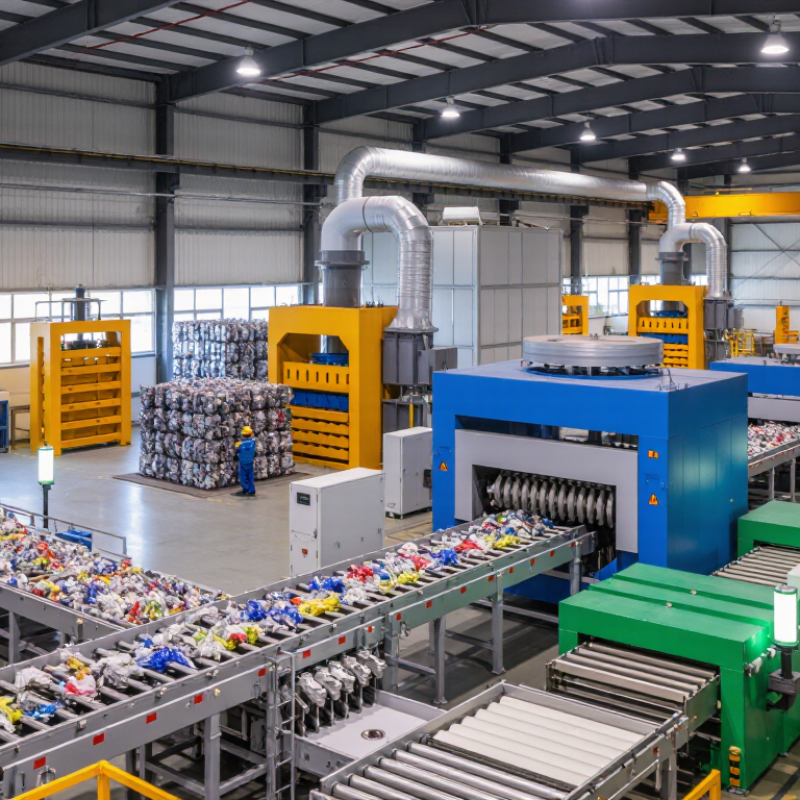
Core functions begin with feeding and size reduction. Conveyors move materials steadily, while shredders, crushers, and granulators reduce bulky items into manageable pieces. Magnetic separators remove ferrous metals. Eddy-current systems can separate non-ferrous metals. Optical sorters identify materials by color or composition. Washing, drying, and compacting equipment can improve the value of recovered outputs.
Real operating conditions matter more than attractive specifications. Dust, moisture, mixed materials, and irregular feeding often reduce efficiency. During equipment trials, operators should check throughput, power use, noise, maintenance access, and separation accuracy. A clear control panel helps, but trained workers remain essential. Safety guards, emergency stops, and enclosed transfer points should be inspected regularly.
No line performs perfectly. That matters. A machine designed for clean plastic may struggle with labels, food residue, or layered packaging. Buyers should test representative waste samples before selecting equipment. They should also request service records, spare-parts availability, and measurable performance data. The best industrial recycling equipment is therefore not simply the fastest option. It is the system that matches local material conditions, workforce skills, facility space, and long-term operating costs.
Industrial recycling equipment is selected according to the waste stream, required recovery rate, and material output. For electronic waste, the core process normally combines sorting, dismantling, shredding, magnetic separation, eddy-current separation, air classification, and dust control.
Global e-waste trend: E-waste generation increased from 53.6 million tonnes in 2019 to 62.0 million tonnes in 2022, while the documented formal collection and recycling rate reached 22.3% in 2022. This growth increases the need for integrated recycling lines with efficient sorting and material separation equipment.
Source: The Global E-waste Monitor 2024, published by UNITAR and the International Telecommunication Union.
What Is the Best Industrial Recycling Equipment in China?
The best industrial recycling equipment depends on material, daily volume, and factory space. In China, most recycling plants combine several machine types instead of using one universal system. Sorting equipment separates materials by size, weight, color, or metal content. Trommel screens remove oversized pieces, while magnetic and eddy-current separators recover different metals. Optical sorters can identify selected plastics, but they need clean sensors and steady material flow.
Shredders reduce bulky items into manageable pieces. Granulators produce smaller, more uniform particles, especially for plastic processing. For paper, cardboard, and flexible packaging, balers compress loose material into dense blocks. This saves storage space and reduces transport costs. Plastic washing lines add soaking, friction washing, rinsing, drying, and pelletizing stages. Each stage affects final quality. Poor drying can still cause trouble.
Experienced operators usually inspect moisture, contamination, noise, and power use before choosing equipment. A machine with high capacity may perform poorly when feedstock changes every hour. Maintenance access matters too. Knives need regular inspection, and screens can clog unexpectedly. A perfect recycling line is rare. Even reliable equipment needs trained workers, spare parts, and careful process records. Local installation conditions and applicable environmental requirements should guide the final design.
What Is the Best Industrial Recycling Equipment in China?
How to Evaluate Equipment Performance, Capacity, and Material Compatibility
Selecting industrial recycling equipment in China requires more than comparing purchase prices. Performance must be measured with the material you actually process. Ask for a controlled trial using representative feedstock. Record throughput, recovery rate, power use, noise, and downtime. Do not rely on a brochure’s maximum capacity. That figure may assume dry, uniform material. Real feedstock is rarely so cooperative.
Capacity should be expressed as a stable hourly range, not one impressive number. Test at normal loading, then observe the machine during overload recovery. Check conveyor speed, chamber size, screen openings, and feeding consistency. Small bottlenecks can reduce an entire line’s output. Request maintenance logs, inspection records, and independently verifiable test data. Useful evidence beats confident sales language. Still, data can be incomplete.
Material compatibility deserves equal attention. Plastic flakes, metal fragments, rubber, textiles, and wet residues behave differently. Measure moisture, density, hardness, contamination, and particle size before choosing a process. Ask whether cutters, magnets, screens, or compactors tolerate abrasive materials. Review wear-part life and replacement time in realistic conditions. An economical machine can become expensive when cleaning takes hours. No test is perfect. A clean factory trial can mislead. Visit an operating installation if possible, and question its operators directly.
China’s recycling industries require equipment matched to material quality, local waste patterns, and available floor space. A single machine rarely solves every problem. Municipal sorting plants often combine bag openers, trommel screens, magnetic separators, and near-infrared optical sorters. These systems separate metals, plastics, paper, and organic fractions at different stages. Dust control and enclosed conveyors matter because fine particles quickly affect sensors and worker comfort.
Construction and demolition facilities use jaw crushers, impact crushers, vibrating screens, and air separators. They process concrete, bricks, wood, and mixed residues into usable aggregates. In metal recovery, shredders work with magnetic and eddy-current separation. Cable granulators can recover copper from insulated wire without damaging the metal. E-waste lines need slower feeding, enclosed processing, and careful sorting for circuit boards, plastics, and recoverable metals. Operators should verify every output stream before resale or reuse.
Food and agricultural waste require a different approach. Dehydration units, screw presses, composting systems, and anaerobic digesters handle wet materials more effectively than standard dry sorting lines. Chinese facilities in coastal cities may face high moisture, while northern sites often manage seasonal freezing and heavier dust. Optical equipment can misread dirty packaging. That weakness is easy to underestimate. Pilot testing should measure recovery rates, electricity use, maintenance time, and noise under real conditions. A technically advanced line may still fail when spare parts arrive late or staff training is rushed. Reliable equipment is not only powerful; it must remain serviceable during ordinary, imperfect operation.
| Equipment Category | Primary Materials | Core Technology and Function | Typical Throughput | Typical Output or Separation Performance | Common Applications in China | Main Selection Considerations |
|---|---|---|---|---|---|---|
| Two-Ram and Channel Balers | Waste paper, cardboard, PET bottles, aluminum cans, textile waste, agricultural film | Hydraulic compression reduces loose material volume and produces wire-tied or strapped bales for storage and transport. | Approximately 3–30 tonnes per hour, depending on material density and bale size | Typical bale density: about 350–650 kg/m³ for paper-based materials; volume reduction commonly exceeds 80%. | Paper recycling Municipal sorting centers, logistics hubs, packaging recovery, textile collection | Feed opening, bale dimensions, moisture tolerance, tying method, hydraulic pressure, and required floor space |
| Trommel Screens | Municipal solid waste, construction waste, compost, soil-like materials, biomass | Rotating perforated drum separates material by particle size while removing fines and oversize fractions. | Approximately 20–150 tonnes per hour | Screening efficiency commonly ranges from 80% to 95%, depending on moisture, particle shape, and aperture design. | MSW sorting Construction and demolition waste processing, compost screening, landfill recovery | Drum diameter and length, aperture pattern, sticky-material handling, wear resistance, and cleaning access |
| Air Classifiers and Zig-Zag Separators | Light plastics, paper, film, fibers, wood fragments, and heavy inert materials | Controlled airflow separates materials according to aerodynamic behavior, density, and shape. | Approximately 5–40 tonnes per hour | Light-fraction separation purity can commonly reach 80%–95% with suitable upstream screening. | Mixed waste RDF preparation, packaging waste, construction waste, and material recovery facilities | Airflow control, dust management, moisture level, feed uniformity, and integration with cyclones or filters |
| Magnetic Drum and Overband Separators | Ferrous steel, iron fragments, steel cans, and ferrous contamination | Permanent magnets or electromagnetic systems extract ferrous metals from conveyed material. | Approximately 10–200 tonnes per hour | Ferrous removal can exceed 95% when particle size, belt speed, and magnet positioning are properly matched. | Metal recovery Scrap yards, municipal waste plants, slag processing, and construction waste recycling | Magnetic field strength, suspension height, belt speed, material burden depth, and tramp-metal protection |
| Eddy Current Separators | Aluminum cans, copper, brass, and other non-ferrous conductive metals | A high-speed magnetic rotor induces eddy currents that repel non-ferrous metals from the waste stream. | Approximately 5–30 tonnes per hour | Non-ferrous recovery commonly reaches 85%–95% for correctly sized and well-prepared feedstock. | Non-ferrous sorting Packaging recovery, bottom ash processing, electronic waste pre-sorting | Rotor speed, belt width, particle size distribution, material layer thickness, and pre-removal of ferrous metals |
| Optical Near-Infrared Sorters | PET, HDPE, PP, mixed plastics, paper, cartons, and colored packaging | Near-infrared sensors identify polymer or fiber types, while air jets eject selected materials from the conveyor stream. | Approximately 2–8 tonnes per hour per sorting lane | Sorting purity of 90%–98% is achievable in suitable streams; actual recovery depends on feed preparation and target material. | High-value sorting Plastic packaging, paper mills, bottle-to-bottle preparation, and automated MRFs | Sensor resolution, belt speed, material presentation, black-plastic detection, moisture, dust, and software configuration |
| Plastic Shredders and Granulators | Post-industrial plastics, rigid packaging, pipes, films, agricultural plastics, and production scrap | Low-speed shredding performs size reduction; high-speed granulation creates more uniform flakes for washing or extrusion. | Approximately 100–2,000 kg per hour for common plastic lines; larger systems may exceed this range | Output particle size commonly ranges from 8–50 mm, depending on screen and knife configuration. | Plastic recycling Injection-molding scrap, packaging recovery, pipe recycling, and agricultural film processing | Material hardness, bulk density, screen size, knife geometry, energy use, dust control, and contamination level |
| Plastic Washing and Friction-Washing Lines | Post-consumer PET, HDPE, PP, films, and rigid plastic containers | Combines pre-shredding, friction washing, hot or cold washing, float-sink separation, dewatering, and drying. | Approximately 300–3,000 kg per hour for modular lines | Washed flake moisture may be reduced to around 1% or lower after thermal or mechanical drying; quality depends on contamination. | Flake production Packaging recycling, agricultural film recovery, and recycled plastic feedstock preparation | Water consumption, wastewater treatment, label and adhesive removal, polymer compatibility, drying efficiency, and odor control |
| PET Bottle Washing and Flake Lines | Post-consumer PET bottles, caps, labels, and preforms | Uses sorting, delabeling, crushing, hot washing, float-sink separation, rinsing, dewatering, and flake drying. | Approximately 500–6,000 kg per hour | High-quality PET flake purity can reach approximately 95%–99% after effective sorting and washing. | PET recovery Fiber production, sheet production, strapping, and recycled PET resin preparation | Color sorting, PVC removal, intrinsic viscosity preservation, caustic-water management, and food-contact compliance requirements |
| Tire Shredders and Rubber Granulation Systems | End-of-life tires, truck tires, passenger-car tires, and rubber products | Sequential cutting, shredding, steel separation, fiber removal, and granulation produce tire chips, rubber mulch, or crumb rubber. | Approximately 1–10 tonnes per hour, depending on tire size and target output | Steel recovery can commonly exceed 95%; crumb rubber sizes typically range from 0.5–5 mm. | Tire recycling Rubberized asphalt, playground surfaces, molded products, and fuel-derived applications | Whole-tire feed size, knife wear, steel and fiber separation, dust suppression, fire prevention, and target granule size |
| Cable Stripping and Wire Granulation Lines | Insulated copper cable, aluminum cable, communication wire, and mixed electrical wire | Stripping removes insulation from selected cable sizes; granulation separates metal granules from plastic through air and vibration systems. | Approximately 100–2,000 kg per hour | Metal recovery commonly reaches 95%–99% when cable types are within the designed diameter range. | Electrical recycling Cable recovery, electrical equipment dismantling, and scrap-metal processing | Input cable diameter, copper or aluminum content, dust filtration, separation accuracy, and prevention of metal oxidation |
| E-Waste Dismantling and Shredding Systems | Waste electrical and electronic equipment, small appliances, computers, circuit boards, and cables | Manual dismantling is combined with controlled shredding, magnetic separation, eddy current separation, and density or optical sorting. | Approximately 0.5–5 tonnes per hour for common small-appliance and mixed e-waste systems | Material recovery often exceeds 80% by mass after multiple separation stages, but varies significantly by product composition. | E-waste recovery Appliance recycling, component recovery, precious-metal pre-concentration, and compliant treatment plants | Hazardous-component removal, dust and fire control, particle size, data security, worker safety, and regulatory compliance |
| Construction and Demolition Waste Recycling Plants | Concrete, bricks, asphalt, masonry, mixed inert waste, and recovered metals | Jaw or impact crushing is combined with screening, magnetic separation, water suppression, and aggregate grading. | Approximately 50–500 tonnes per hour | Recycled aggregate recovery commonly ranges from 70% to 95% for relatively clean inert feedstock. | C&D recycling Urban redevelopment, road construction, recycled aggregate production, and demolition projects | Feed contamination, crusher type, dust suppression, final aggregate grades, mobility, noise, and wear-part costs |
| Food and Organic Waste Treatment Systems | Food waste, kitchen waste, market waste, and source-separated organic waste | Uses depackaging, pulping, screening, dewatering, anaerobic digestion, composting, or combined biological treatment. | Approximately 10–300 tonnes per day | Organic matter diversion can exceed 80% in well-operated source-separated systems; biogas yield varies by feed composition. | Organic recovery Municipal food-waste plants, institutional kitchens, markets, and centralized treatment facilities | Contamination control, odor management, moisture balance, biogas utilization, digestate treatment, and wastewater handling |
| Waste Heat and Energy-Recovery Systems | Suitable refuse-derived fuel, biomass residues, and selected industrial combustible waste | Combustion or thermal conversion is integrated with boilers, heat exchangers, flue-gas treatment, and energy-generation equipment. | Approximately 100–3,000 tonnes per day for large centralized facilities | Electrical efficiency is commonly about 15%–30% for conventional waste-to-energy systems; combined heat and power can achieve higher total energy utilization. | Energy recovery Municipal residual waste, industrial waste, district heating, and process-steam generation | Calorific value, chlorine and moisture content, emissions control, ash treatment, permitting, and continuous monitoring |
The best industrial recycling equipment in China depends on material, contamination, floor space, and daily volume. No machine wins every line. A metal processor may need a heavy-duty shredder, magnetic separator, eddy-current separator, and baler. A plastics operation may need granulators, washing tanks, dryers, and melt filtration. Electronic waste requires controlled dismantling, dust extraction, and precise separation. Equipment should match the feedstock, not merely its advertised capacity.
The Global E-waste Monitor 2024 reported 62 million tonnes of electronic waste generated worldwide in 2022. Only 22.3% was formally collected and recycled. This gap increases demand for traceable, efficient processing systems. For mixed materials, optical sorting can improve purity, while conveyors and trommels support stable feeding. However, published throughput often assumes clean, uniform inputs. Real factory waste is wetter, dirtier, and less predictable. I would test representative samples before approving a purchase. That step is easy to overlook.
Tips: Measure moisture, particle size, contamination, noise, and energy use during a full production shift. Request independent performance data, maintenance records, spare-parts availability, and operator training. The OECD estimated global plastic waste reached 353 million tonnes in 2019, showing why washing and pelletizing lines need strong water-management controls. Track recovery rate, product purity, downtime, and energy consumption monthly. A cheaper machine can become expensive when blades wear quickly or service response is slow. Think beyond the purchase price.